BREAST AUGMENTATION VS BREAST LIFT
Although both procedures are designed to improve breast appearance, breast augmentation and breast lift surgery use different techniques and create different types of changes.
What Does Breast Augmentation Change?
Breast augmentation increases breast volume using implants or, in selected cases, fat transfer. It may be chosen by patients who naturally have smaller breasts or who have lost fullness because of pregnancy, breastfeeding, weight changes, or aging.
Breast augmentation can help:
- Increase breast size
- Restore lost volume
- Improve breast fullness
- Enhance upper breast shape
- Balance breast asymmetry
- Improve body proportions
Breast implants are available in different sizes, profiles, shapes, and materials. Implant placement can also vary depending on the patient’s anatomy, breast tissue, and surgical plan. Implants may be placed behind the breast tissue or beneath the chest muscle.
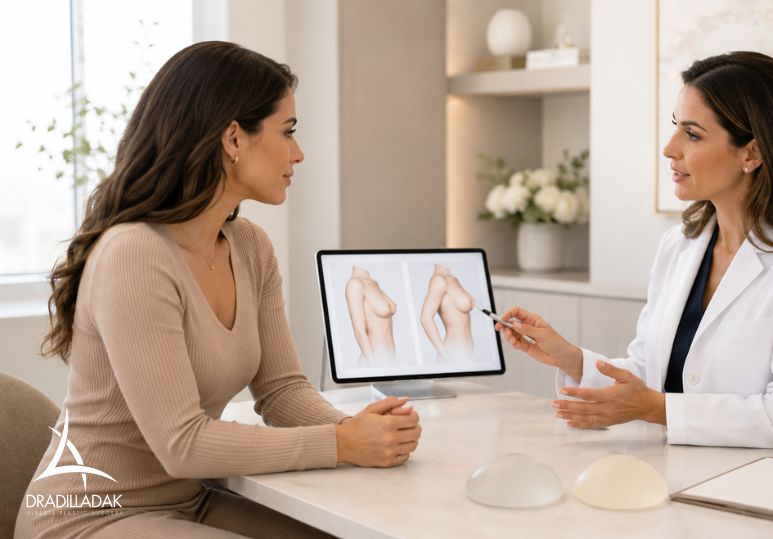
During your consultation, your plastic surgeon will consider more than cup size. Breast width, chest-wall shape, skin elasticity, existing tissue, implant profile, and your desired appearance all matter. The goal is to select an option that works with your natural proportions rather than focusing only on implant volume.
Breast augmentation may create a rounder or fuller breast shape, but an implant does not automatically correct significant sagging. Adding too much volume to loose or stretched breast skin may create a heavier appearance without properly repositioning the breast tissue or nipples.
What Does a Breast Lift Change?
A breast lift, medically known as mastopexy, removes excess skin and reshapes the existing breast tissue to raise the breasts on the chest. The nipple and areola may also be repositioned to create a more lifted and balanced appearance.
A breast lift can help address:
- Sagging breasts
- Stretched breast skin
- Low nipple position
- Downward-pointing nipples
- Enlarged areolas
- Uneven breast position
- Loss of breast shape
A lift does not usually create a major increase in breast size or substantially add fullness to the upper breast. The American Society of Plastic Surgeons explains that a breast lift does not significantly change breast size or create the same upper-breast roundness that implants can provide.
Some patients feel that their breasts look slightly smaller after a lift because loose tissue has been reshaped into a firmer and more compact position. However, the amount of natural breast tissue remains an important factor in the final result.
A breast lift may be the better option when a patient is comfortable with their current breast volume but wants the breasts to sit higher, feel firmer, or have an improved nipple position.
Understanding the Role of Scars
Every surgical incision creates a scar. Breast augmentation can sometimes be completed through a relatively short incision, although incision location depends on the surgical approach.
Breast lift incisions are usually more extensive because the surgeon must remove skin and reshape the breast. Depending on the amount of lifting required, the incision pattern may be placed:
- Around the areola
- Around the areola with a vertical line
- Around the areola, vertically downward, and along the breast crease
Patients with mild sagging may require fewer incisions than those who need a more substantial lift. Scars generally soften and fade with time, but they do not disappear completely.
The trade-off is that a breast lift can make changes that an implant alone cannot reliably produce. Patients must decide whether the improvement in breast position and shape is worth the additional scarring. Your plastic surgeon can explain the expected incision pattern after examining your breasts and assessing how much skin needs to be removed.
WHICH BREAST PROCEDURE MAY MATCH YOUR GOALS?
The most useful starting point is identifying what you dislike about your current breast appearance. Size, position, shape, and fullness are separate concerns, even though they can occur together.
You May Prefer Breast Augmentation If You Want More Volume
Breast augmentation may be appropriate when your primary goal is to increase breast size or restore fullness.
You may be a potential candidate if:
- Your breasts feel too small for your proportions
- Pregnancy or weight loss reduced breast volume
- The upper breasts appear empty
- One breast is noticeably smaller
- Your nipples remain in a reasonably elevated position
- Your skin has enough elasticity to support an implant
Patients sometimes use the nipple’s position relative to the breast crease as a basic way to understand whether sagging may be present. However, online tests cannot accurately determine which operation you need. Breast shape, tissue quality, nipple direction, skin elasticity, and implant size must all be considered together.
A consultation is especially important for patients with mild sagging. A carefully selected implant may improve fullness enough to create the desired result in some cases. In others, using an implant without a lift may make sagging more noticeable.
You May Prefer a Breast Lift If Position Is the Main Concern
A breast lift may be more suitable when you are generally satisfied with your breast size but unhappy with sagging or nipple position.
You may be a potential candidate if:
- Your breasts sit lower than desired
- Your nipples point downward
- Your nipples fall below the breast crease
- Your skin has stretched after pregnancy or weight loss
- Your areolas have become enlarged
- Your breasts have a flattened or elongated shape
- One breast sits lower than the other
A breast lift focuses on using your existing tissue to create a higher and firmer contour. It may provide a natural-looking result without implants when the patient already has enough breast volume.
It is important to have realistic expectations about upper-pole fullness. A lift can reshape and reposition the breast, but it cannot always create the round upper-breast appearance associated with an implant. Patients who want a lifted position and noticeable upper fullness may need both procedures.
Consider Your Desired Breast Size
Ask yourself whether you would be happy with your current breast size if the breasts were repositioned and reshaped.
When the answer is yes, a breast lift may be enough. When the answer is no because you also want greater volume, augmentation may be needed.
It can also help to consider whether you want your breasts to appear:
- Larger
- Higher
- Fuller
- Firmer
- Rounder
- More symmetrical
- More proportional
Many patients have several goals rather than one. For example, a patient may want the nipples raised, loose skin removed, and lost upper-breast volume restored. Those goals may not be fully addressed by a single procedure.
Think About Pregnancy and Weight Changes
Pregnancy, breastfeeding, and significant weight fluctuations can stretch breast skin and alter surgical results. A breast lift cannot prevent future sagging, and implants cannot stop the natural effects of aging or changes in breast tissue.
Patients who are planning a pregnancy soon may choose to postpone surgery until they have completed their family. Pregnancy after breast surgery is possible, but later breast changes could affect the result and lead to interest in another procedure. Mayo Clinic notes that pregnancy may stretch the breasts and offset some of the improvement created by a breast lift.
Maintaining a stable weight before surgery may also support more predictable results. Losing or gaining a substantial amount of weight after surgery can change breast size, skin tension, and symmetry.
Think About Your Willingness to Have Implants
Breast implants can create volume that cannot be achieved through a lift alone, but they also introduce implant-specific considerations. Implants are not considered lifetime devices, and patients may require future monitoring or additional surgery.
Potential implant-related concerns can include:
- Implant rupture
- Capsular contracture
- Changes in position
- Visible rippling
- Breast discomfort
- Changes in sensation
- The need for implant replacement or removal
Patients considering augmentation should understand both the expected benefits and the possibility of future procedures. Those who strongly prefer to avoid implants may still achieve a meaningful improvement through a lift if they have sufficient natural breast tissue.
Fat transfer may be discussed for selected patients who want a modest volume increase without implants. However, fat transfer generally does not provide the same amount of enlargement or predictability as an implant and does not replace the need for a lift when significant sagging is present.
WHEN A BREAST LIFT WITH AUGMENTATION MAY BE BEST
Some patients do not need to choose only one procedure. Breast augmentation and breast lift surgery can be performed together when both breast volume and position need to be improved.
This combined operation is commonly referred to as an augmentation mastopexy.
What Can a Combined Procedure Accomplish?
A breast lift with implants may:
- Increase breast size
- Restore upper fullness
- Remove loose skin
- Raise the breast tissue
- Reposition the nipples
- Improve breast shape
- Address certain asymmetries
The lift reshapes and repositions the natural breast tissue, while the implant adds the desired volume. Combining the procedures can be helpful for patients whose breasts appear both deflated and sagging after pregnancy, breastfeeding, weight loss, or aging.
An implant alone may make the breasts fuller but leave the nipples too low. A lift alone may raise the breasts but not provide enough upper fullness. When both issues are present, combining the procedures may create a more complete change.
Who May Benefit From Combining Both Procedures?
A combined breast lift and augmentation may be considered when:
- You want larger and higher breasts
- Your breasts have lost volume and developed loose skin
- Your nipples sit lower than desired
- You want more upper-breast fullness
- Pregnancy has changed breast size and position
- Weight loss has left the breasts deflated
- Existing implants no longer match your breast shape
- Significant asymmetry involves both size and position
The implant size must be selected carefully. A very large implant places more weight and tension on the breast skin, which may affect scar healing and long-term breast position. The most suitable implant is not necessarily the largest implant that can physically fit.
Your surgeon will balance your volume goals with your skin quality, tissue strength, breast width, and desired proportions.
Can the Procedures Always Be Performed Together?
Breast augmentation and breast lift surgery can often be completed during one operation, but that is not appropriate for every patient. In some situations, a surgeon may recommend performing the lift and augmentation in separate stages.
Staging may be considered when:
- A substantial lift is required
- The patient wants a significant size increase
- The skin or tissue is very thin
- Blood supply to the nipple requires additional caution
- Previous breast surgery has affected the tissue
- The surgeon wants the breast shape to heal before selecting implants
The American Society of Plastic Surgeons notes that implants may be inserted during the lift or during a separate procedure, depending on the patient and surgeon’s assessment.
A staged approach requires two operations and two recovery periods, but it may provide greater control in complex cases. Your plastic surgeon should explain why a one-stage or staged procedure is being recommended.
Comparing Recovery Requirements
Recovery varies according to the procedure and the individual patient. Breast augmentation often creates chest pressure, tightness, and muscle soreness, particularly when implants are placed beneath the chest muscle.
Breast lift recovery involves healing of the reshaped tissue and longer incisions. A combined procedure requires the body to recover from both implant placement and breast lifting.
Patients should expect temporary swelling, bruising, tenderness, firmness, and changes in sensation. A supportive surgical bra may be required, and lifting, strenuous exercise, and upper-body activity will be restricted during early healing.
Many patients can return to nonphysical work within approximately one to two weeks, but complete healing takes longer. Your surgeon will determine when it is safe to drive, exercise, lift children, sleep on your side, wear underwire bras, and return to demanding work.
Questions to Ask During Your Consultation
A consultation should help you understand which procedure is recommended and why. Consider asking:
- Is breast size or breast position my main concern?
- Will an implant alone correct my breast shape?
- Do I have enough natural tissue for a lift without implants?
- Where will my nipples sit after surgery?
- What incision pattern will I need?
- What implant size and profile suit my proportions?
- Should my procedures be combined or staged?
- How will surgery affect existing asymmetry?
- What will my scars look like?
- What recovery restrictions should I expect?
- How could pregnancy or weight changes affect my results?
- What future monitoring may be required?
Photographs can help communicate your preferences, but they should be treated as inspiration rather than a guaranteed result. Every patient has different breast tissue, chest dimensions, skin quality, and starting proportions.
Making an Informed Decision
A breast lift and breast augmentation are not interchangeable procedures. Augmentation adds or restores volume, while a lift raises and reshapes breasts affected by sagging. When both concerns are present, combining the procedures may offer the most balanced improvement.
The right choice depends on your anatomy and goals, not simply the procedure name that sounds most appealing. A qualified plastic surgeon can assess your breast position, skin elasticity, tissue volume, nipple placement, chest proportions, and medical history before recommending a surgical plan.
Patients considering breast augmentation, breast lift surgery, or a combined procedure in Edmonton can schedule a consultation with Alberta Plastic Surgery. Your consultation provides an opportunity to discuss your desired breast size and shape, compare procedure options, review expected scarring and recovery, and develop a treatment plan designed around your individual anatomy and goals.