
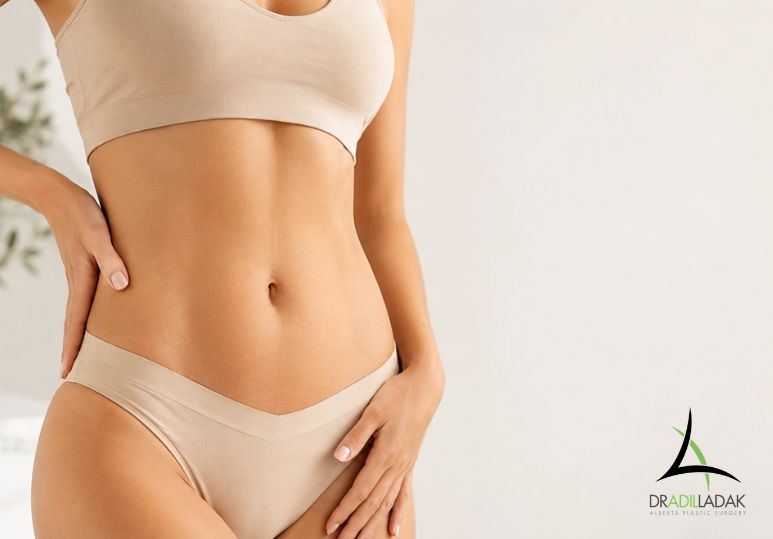
HOW LIPOSUCTION REMOVES BELLY FAT
Liposuction removes localized fat deposits from beneath the skin using a thin surgical tube called a cannula. The surgeon makes small incisions in the treatment area and carefully removes selected fat while shaping the surrounding tissues to create a smoother abdominal contour.
Unlike traditional weight loss, which primarily causes existing fat cells to become smaller, liposuction physically removes a portion of the fat cells from the treated area. Those removed cells do not regenerate in the same way. This is why the reduction created by liposuction can be considered permanent.
Common abdominal treatment areas can include:
- Lower abdomen
- Upper abdomen
- Waist
- Flanks
- Love handles
- Lower back
Treating several connected areas may sometimes create a more balanced result than focusing on one isolated pocket of fat. For example, abdominal liposuction may be combined with treatment of the flanks when the goal is greater definition through the waist.
The amount of fat removed varies according to your anatomy, health, goals, skin quality, and what can be removed safely. Liposuction should not be approached as a way to remove as much fat as possible. The objective is controlled body contouring.
Does the Fat Actually Stay Gone?
The fat cells physically removed during liposuction are permanently eliminated from the treated area. However, some fat cells must remain.
If you maintain a relatively stable body weight, the improvement created through liposuction can be long-lasting. The American Society of Plastic Surgeons notes that maintaining healthy nutrition and fitness can help preserve the loss of excess fatty tissue following treatment.
Weight gain after surgery changes the situation.
Remaining fat cells throughout the body can increase in size when additional energy is stored. That includes fat cells that remain in the abdomen. Therefore, gaining weight can gradually reduce the definition achieved through liposuction.
Smaller amounts of weight gain may be distributed across the body, while more significant weight gain can noticeably alter the treated area and surrounding proportions.
This distinction is important when patients hear that liposuction is permanent. The removed fat cells are permanently gone, but your ability to gain body fat is not.
What Kind of Belly Fat Can Liposuction Remove?
Not all abdominal fat is the same.
Liposuction targets subcutaneous fat, which is the fat located beneath the skin. This is usually the softer fat that you can pinch between your fingers.
Another type of abdominal fat, known as visceral fat, sits deeper inside the abdomen around the internal organs. Liposuction cannot safely reach or remove this internal fat.
Someone with a relatively firm, rounded abdomen caused primarily by visceral fat may therefore see limited improvement from liposuction, even if the stomach appears prominent.
Lifestyle changes and medical guidance may be more appropriate for reducing visceral fat.
During a consultation, a plastic surgeon can evaluate whether the fullness you are concerned about comes primarily from removable subcutaneous fat, internal fat, loose skin, muscle separation, or a combination of factors.
Is Liposuction a Weight-Loss Procedure?
No. Liposuction is designed to reshape selected areas rather than produce substantial overall weight loss.
The American Society of Plastic Surgeons specifically describes liposuction as a procedure intended for people who have localized excess fat and notes that it is not a treatment for obesity or a replacement for diet and exercise.
Good candidates are often already reasonably close to their preferred or stable weight but have areas that remain resistant to lifestyle changes.
For example, someone may exercise consistently and maintain a healthy routine but still notice:
- A lower abdominal pouch
- Persistent love handles
- Fat around the waist
- Uneven abdominal contours
- Localized fullness after weight changes
Liposuction can address these proportions more directly than additional generalized weight loss.
WHEN BELLY FAT MAY NEED MORE
One of the most important parts of choosing abdominal contouring is understanding what is creating the appearance you want to change.
Liposuction removes fat. It does not directly remove significant excess skin or repair separated abdominal muscles.
This becomes particularly important after pregnancy, major weight loss, or aging.
Liposuction Does Not Remove Loose Skin
When abdominal skin has good elasticity, it may gradually conform to the slimmer contour after fat is removed. Patients with firmer, more elastic skin generally have a better chance of achieving a smooth result.
However, skin that has been significantly stretched may not tighten enough after liposuction.
Examples can include:
- Loose skin after pregnancy
- Skin following substantial weight loss
- Significant stretch marks
- Age-related loss of elasticity
- An abdominal overhang
- Pronounced skin laxity
Removing fat underneath very loose skin may actually make the looseness more noticeable because there is less volume supporting the skin.
In these situations, a tummy tuck may provide a more appropriate solution.
Liposuction vs Tummy Tuck
Although they are frequently discussed together, liposuction and abdominoplasty, commonly called a tummy tuck, solve different problems.
Liposuction primarily targets excess fat.
A tummy tuck primarily targets loose skin and abdominal-wall concerns while also allowing excess fat to be addressed when appropriate.
A tummy tuck typically removes redundant abdominal skin and can repair separated abdominal muscles when needed. Liposuction may be incorporated into the procedure to improve contour around the abdomen, waist, or flanks.
You may be more likely to consider liposuction alone when you have:
- Localized abdominal fat
- Relatively firm skin
- Minimal skin sagging
- Stable weight
- Good abdominal muscle support
A tummy tuck may deserve consideration when you have:
- Significant loose skin
- An abdominal skin fold
- Muscle separation after pregnancy
- Substantial skin stretching
- A combination of excess skin and fat
Some patients fall between these categories, which is why physical examination is important.
What About Abdominal Muscle Separation?
Pregnancy can cause the two sides of the abdominal muscles to separate, a condition called diastasis recti.
This can create a persistent abdominal bulge even when the patient has relatively little excess fat.
Because liposuction works within the fatty layer beneath the skin, it does not tighten or reconnect separated abdominal muscles. Removing fat may improve the surrounding contour, but it will not correct the underlying structural problem.
When significant muscle separation is contributing to abdominal protrusion, a tummy tuck with muscle repair may be recommended instead.
What About Cellulite and Stretch Marks?
Liposuction should not be expected to eliminate cellulite or stretch marks.
Cellulite is caused by the relationship between fat, connective tissue, and the skin. Liposuction removes deeper fat deposits but does not reliably correct the fibrous bands responsible for cellulite. The American Society of Plastic Surgeons specifically notes that liposuction is not an effective cellulite treatment.
Stretch marks are changes within the skin itself. Because most abdominal skin remains in place during liposuction, stretch marks generally remain as well.
Some stretch marks may be physically removed during a tummy tuck when they are located within the skin being excised, but even a tummy tuck cannot guarantee complete stretch-mark removal.
Setting realistic expectations about these limitations helps prevent confusion about what abdominal liposuction can accomplish.
KEEPING LIPOSUCTION RESULTS LONG TERM
The best way to think about liposuction results is that the procedure creates a new abdominal contour that you then need to maintain.
Once healing is complete, the treated area contains fewer fat cells than it did before surgery. Maintaining a relatively consistent weight helps preserve that change. Mayo Clinic notes that liposuction results usually remain long-lasting when body weight is maintained.
What Happens If You Gain Weight?
A common misconception is that weight gained after liposuction automatically moves somewhere completely different.
The reality is more nuanced.
The remaining fat cells throughout your body can expand when you gain weight. Because the treated area contains fewer fat cells than before, your proportions may still remain somewhat improved following moderate weight gain. However, substantial weight gain can eventually alter the surgical result considerably.
The abdomen can still gain fat.
Other areas may also become fuller depending on your genetics and natural fat-distribution pattern.
For this reason, liposuction is generally most appropriate when you are already at a weight that you believe you can realistically maintain.
Should You Lose Weight Before Liposuction?
If you are actively planning significant weight loss, it may make sense to reach a more stable weight before pursuing liposuction.
Losing a substantial amount of weight after surgery can change:
- Skin laxity
- Abdominal shape
- Fat distribution
- Body proportions
- Overall treatment goals
Your surgeon may recommend maintaining a stable weight for a period before surgery so that the treatment plan reflects your longer-term body shape rather than a temporary stage during weight loss.
The goal does not need to be achieving an arbitrary number on the scale. Instead, patients should ideally be at a healthy, sustainable weight that reflects their usual lifestyle.
Can Pregnancy Change Liposuction Results?
Yes.
Pregnancy can stretch abdominal skin, alter fat distribution, separate abdominal muscles, and change the contour of the waist and stomach.
Having liposuction does not prevent future pregnancy, but pregnancy after the procedure may change the aesthetic result.
Patients who know that pregnancy is planned in the near future may wish to discuss timing with their surgeon. Depending on the procedure and individual priorities, postponing abdominal contouring until after pregnancy may produce a more predictable long-term result.
How Long Until You See the Final Result?
Liposuction results are not immediate because swelling can temporarily hide the new contour.
During the first several weeks, the treated abdomen may look swollen, firm, uneven, or even temporarily larger than expected.
As swelling decreases, abdominal definition gradually becomes easier to see. Mayo Clinic notes that the treated area generally becomes slimmer over several months as swelling resolves.
Recovery can include:
- Swelling
- Bruising
- Tenderness
- Temporary numbness
- Firmness
- Fluid retention
- Compression garments
The exact timeline depends on the extent of treatment, number of areas treated, your healing response, and your surgeon's technique.
Compression garments are often recommended during early recovery to support the tissues and help control swelling. Activity restrictions should be followed carefully even if you begin feeling better quickly.
Who Is a Good Candidate for Abdominal Liposuction?
Liposuction may be worth discussing when you have localized abdominal fat that remains despite healthy lifestyle habits.
Potential candidates generally have:
- Relatively stable weight
- Localized subcutaneous fat
- Reasonably elastic skin
- Realistic expectations
- Good overall health
- A willingness to follow recovery instructions
- Clear body-contouring goals
Patients with significant loose skin, substantial visceral fat, muscle separation, or expectations of major weight loss may require another treatment strategy.
Your consultation should determine what is actually responsible for the abdominal shape you are concerned about rather than assuming liposuction is automatically the appropriate treatment.
Making Liposuction Results Last
Long-term maintenance does not require becoming obsessive about small weight fluctuations. Normal changes happen.
Instead, focus on maintaining the general lifestyle that allowed you to reach a stable weight before surgery.
Helpful habits can include:
- Consistent physical activity
- Balanced nutrition
- Adequate hydration
- Stable weight management
- Avoiding major weight cycling
- Following your surgeon's recovery plan
- Attending scheduled follow-up appointments
Liposuction can change your proportions, but it does not change the biological processes that influence weight gain.
The procedure works best when it is viewed as a body-contouring tool rather than a shortcut around long-term health habits.
So, can liposuction remove belly fat permanently? The fat cells physically removed during abdominal liposuction are permanently gone. However, remaining fat cells can still enlarge, your body can still gain weight, and pregnancy or aging can alter the shape of the abdomen over time.
For appropriately selected patients, maintaining a stable weight can allow abdominal liposuction results to remain visible for many years.
Patients considering liposuction in Edmonton can schedule a consultation with Alberta Plastic Surgery to discuss their abdominal concerns, skin quality, body-contouring goals, and whether liposuction or another procedure may provide the most appropriate approach. A personalized assessment can help determine whether the fullness is caused by removable abdominal fat, loose skin, muscle separation, or a combination of concerns.
FAQs
Q: DOES LIPOSUCTION PERMANENTLY REMOVE BELLY FAT?
A: Yes. The fat cells physically removed during liposuction are permanently eliminated from the treated area. However, the remaining fat cells can still enlarge if you gain weight. Maintaining a relatively stable weight after surgery can help preserve the slimmer abdominal contour created through liposuction.
Q: CAN BELLY FAT COME BACK AFTER LIPOSUCTION?
A: The removed fat cells do not grow back, but your body can still store fat in the remaining cells. Significant weight gain may cause the abdomen and other areas of the body to become fuller again. Liposuction results are generally longest-lasting when patients maintain consistent nutrition, exercise, and weight-management habits.
Q: IS LIPOSUCTION BETTER THAN A TUMMY TUCK FOR BELLY FAT?
A: It depends on what is causing the abdominal concern. Liposuction is generally better suited for localized fat when the skin has good elasticity. A tummy tuck may be more appropriate when loose skin, stretched abdominal tissue, or muscle separation is also present. A consultation can determine which procedure better matches your anatomy and goals.