START WITH TRAINING AND CREDENTIALS
The first step in comparing plastic surgeons is confirming that the physician has appropriate specialist training.
Terms such as “cosmetic surgeon” can sometimes create confusion because they do not necessarily indicate the same training as certification in plastic surgery. The Canadian Society of Plastic Surgeons recommends confirming whether a prospective surgeon is certified in plastic surgery rather than relying only on marketing language or general references to board certification.
Verify Plastic Surgery Certification
In Canada, Royal College certification is an important credential to look for when researching a plastic surgeon.
Royal College certification reflects specialist training and successful completion of the required assessment and examination process. It is different from a provincial medical licence, which gives a physician permission to practise medicine within a particular jurisdiction.
Patients can also use the Royal College's public directory to search for specialists and view listed certifications.
When researching a surgeon, consider checking:
- Specialty certification
- Medical licence
- Surgical training
- Professional memberships
- Hospital affiliations
- Procedure experience
Do not hesitate to ask the surgeon directly about their training. A qualified surgeon should be comfortable discussing where they trained, their certification, and the types of procedures they regularly perform.
Check the Alberta Physician Directory
Plastic surgeons practising in Alberta are regulated by the College of Physicians & Surgeons of Alberta, commonly known as CPSA.
CPSA provides a public Physician Directory that can be used to review information including a physician's practice type, qualifications, location, and conditions that may exist on their practice permit.
This provides patients with another way to independently verify information rather than relying entirely on a clinic website.
The Canadian Society of Plastic Surgeons specifically recommends checking with the provincial college to confirm that a surgeon is licensed and to determine whether disciplinary action has been taken.
Credential checking may feel formal, but it is a reasonable part of making an informed medical decision.
Look for Relevant Experience
Plastic surgery includes many different procedures involving the face, breasts, and body.
A surgeon may be fully qualified while still having particular areas of interest or greater experience with certain operations.
If you are considering a facelift, ask how frequently the surgeon performs facial surgery. If you want breast augmentation, ask about their experience with breast implants, different placement techniques, and revision procedures.
The same principle applies to:
- Tummy tuck
- Liposuction
- Breast lift
- Breast reduction
- Eyelid surgery
- Neck lift
- Body contouring
The Canadian Society of Plastic Surgeons recommends asking how often a prospective surgeon performs the procedure you are considering and discussing complication rates.
Experience does not guarantee a perfect result, but regular familiarity with the operation can be an important part of your decision.
Consider Procedure-Specific Results
Before-and-after photographs can help you understand a surgeon's aesthetic approach.
Instead of looking only for dramatic transformations, pay attention to patients who have a similar starting anatomy or concern.
Look at factors such as:
- Proportion
- Symmetry
- Scarring
- Contour
- Incision placement
- Natural appearance
- Consistency
For facial procedures, consider whether results still resemble the individual rather than looking overly altered.
For breast surgery, examine whether breast shape and proportions appear balanced with the patient's frame.
For body contouring, pay attention to the smoothness of transitions between treated and untreated areas.
Photographs cannot predict your result, but they can help you understand the type of work a surgeon commonly performs.
USE THE CONSULTATION TO COMPARE SURGEONS
A consultation is more than an opportunity to receive a price quote.
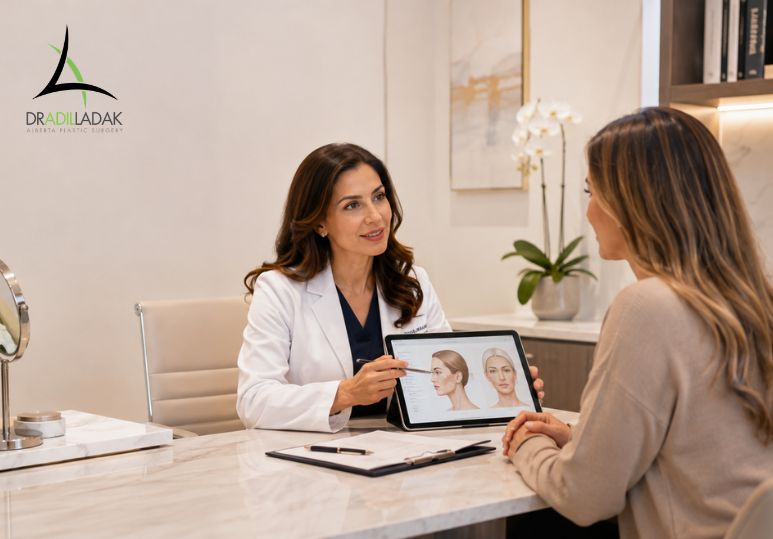
It allows the surgeon to evaluate your anatomy, medical history, expectations, and treatment options. It also gives you an opportunity to evaluate the surgeon.
You should leave the consultation understanding what is being recommended and why.
Pay Attention to Communication
A good surgical consultation should feel like a two-way conversation.
The surgeon should listen to what you want to change before recommending a procedure. They should also be willing to explain when a requested treatment may not produce the result you expect.
Good communication may include discussing:
- Your goals
- Treatment options
- Alternatives
- Incision placement
- Scarring
- Recovery
- Risks
- Limitations
- Expected results
You should feel comfortable asking questions without feeling rushed or dismissed.
The Canadian Society of Plastic Surgeons emphasizes discussing expectations carefully and understanding how complications and follow-up care would be managed.
A surgeon who explains limitations can sometimes be more reassuring than one who promises an ideal result.
Be Careful With Guarantees
No ethical surgeon can guarantee a perfect cosmetic outcome.
Bodies heal differently, scars develop differently, and every surgical procedure carries potential risks.
Be cautious if someone:
- Guarantees results
- Minimizes recovery
- Dismisses complications
- Pressures you to book quickly
- Pushes additional procedures
- Makes unrealistic promises
The Canadian Society of Plastic Surgeons specifically advises patients to be wary of surgeons who guarantee satisfaction or minimize risks and recovery.
Good plastic surgery planning includes discussing both potential improvements and realistic limitations.
Ask Why a Procedure Is Recommended
Patients sometimes arrive at consultations believing they already know which operation they need.
However, the procedure you have researched online may not actually address the concern you are experiencing.
For example, someone requesting liposuction may primarily have loose abdominal skin and benefit more from a tummy tuck. Someone requesting breast implants may have significant sagging that requires a breast lift.
A thoughtful surgeon should explain the relationship between your anatomy and the recommended operation.
Ask questions such as:
- Why is this procedure appropriate for me?
- Are there alternatives?
- What will this procedure not correct?
- Would combining procedures improve the result?
- Would staging procedures be safer?
- What result is realistic for my anatomy?
Understanding the reasoning behind the recommendation can help you make a more confident decision.
Discuss Risks Openly
Every surgical procedure carries risks.
The exact risks depend on the operation, but possible complications may include infection, bleeding, delayed wound healing, scarring, asymmetry, changes in sensation, anesthesia-related complications, and the possibility of revision surgery.
Procedure-specific risks should also be discussed.
For example, breast augmentation has implant-related considerations, while tummy tuck surgery has different healing and mobility concerns.
A surgeon should be willing to explain:
- Common complications
- Uncommon complications
- Warning signs
- How complications are treated
- When to contact the clinic
- Whether revision surgery might be required
You should not feel that asking about complications makes you a difficult patient. Understanding risk is part of informed consent.
Ask About the Surgical Facility
Where your operation takes place matters.
Depending on the procedure, surgery may be performed in a hospital, accredited surgical facility, or appropriately equipped operating suite.
The Canadian Society of Plastic Surgeons recommends asking about hospital admitting privileges and whether an office-based operating suite is certified.
You can ask:
- Where will my surgery take place?
- Who will provide anesthesia?
- What emergency equipment is available?
- What happens if I require hospital care?
- Who monitors me after surgery?
- What safety standards does the facility follow?
These questions are particularly important when surgery requires general anesthesia or involves multiple procedures.
Understand Who Provides Anesthesia
Patients often spend significant time researching their surgeon but little time thinking about anesthesia.
Ask who will administer your anesthesia and what qualifications that person has.
The Canadian Society of Plastic Surgeons recommends confirming that the individual providing anesthesia is appropriately certified.
Your surgical team should explain what type of anesthesia is planned and what you can expect before and after the operation.
LOOK BEYOND PRICE AND ONLINE REVIEWS
Cost and reviews can both influence your decision, but neither should be the primary factor used to select a surgeon.
Cosmetic surgery is a medical procedure. Comparing surgeons solely by price can overlook important differences in training, facility standards, anesthesia, follow-up care, and surgical planning.
Understand What the Quote Includes
Plastic surgery quotes may include several components.
Depending on the procedure, these may involve:
- Surgeon fees
- Facility fees
- Anesthesia
- Implants
- Surgical garments
- Medications
- Follow-up visits
Ask whether the quote includes all expected surgical costs and what circumstances could create additional expenses.
You should also understand what happens financially if a revision procedure is required.
The least expensive quote is not automatically the best value, just as the most expensive surgeon is not automatically the best choice.
Focus on qualifications, safety, communication, and whether the surgeon's recommendations make sense for you.
Use Reviews Carefully
Online reviews can provide insight into patient experiences, particularly around communication, clinic organization, staff interactions, and follow-up.
However, reviews have limitations.
Highly positive reviews do not guarantee your surgical result, and individual negative reviews do not always provide enough context to evaluate the quality of medical care.
Instead of focusing only on star ratings, look for patterns.
Do multiple patients mention:
- Clear communication?
- Good follow-up?
- Realistic expectations?
- Respectful staff?
- Organized care?
- Support during recovery?
Reviews should be one piece of your research rather than the deciding factor.
Pay Attention to Follow-Up Care
Your relationship with your plastic surgeon does not end when surgery is finished.
Follow-up appointments allow the surgical team to assess healing, remove or check dressings when necessary, monitor swelling, evaluate incisions, and identify potential complications.
Ask what postoperative care is included.
You should know:
- When the first follow-up occurs
- How many appointments are expected
- Who you contact after hours
- What happens if you have a concern
- Who evaluates complications
- How long the surgeon follows your recovery
The Canadian Society of Plastic Surgeons recommends asking what follow-up care will be provided and how the surgeon would respond if complications develop.
Feeling supported after surgery can be just as important as feeling comfortable during the consultation.
Consider How You Feel About the Surgeon
Credentials and experience matter, but trust also matters.
You should feel comfortable discussing personal concerns with your surgeon and confident that they understand your goals.
A good fit does not necessarily mean the surgeon agrees with everything you request. In some cases, the most responsible recommendation may be to choose a different procedure, reduce the extent of surgery, lose additional weight, stop smoking, wait until after pregnancy, or avoid surgery altogether.
A surgeon who is willing to say no when necessary may be prioritizing your safety and long-term outcome over booking a procedure.
Compare More Than One Surgeon If Needed
There is nothing wrong with attending more than one consultation.
Meeting different surgeons can help you compare:
- Recommendations
- Communication
- Surgical plans
- Recovery expectations
- Before-and-after results
- Facility standards
- Cost
- Overall comfort
If two surgeons recommend completely different procedures, ask each to explain their reasoning.
The goal is not necessarily to find the surgeon who tells you what you most want to hear. It is to find someone whose recommendations are supported by appropriate training, thoughtful assessment, and realistic expectations.
Questions to Bring With You
Preparing questions before your consultation can help you remember important topics.
Consider asking:
- Are you certified in plastic surgery?
- How often do you perform this procedure?
- Am I a good candidate?
- What alternatives should I consider?
- Where will surgery take place?
- Who provides anesthesia?
- What scars should I expect?
- What are the main risks?
- What is recovery like?
- When can I return to work?
- What happens if I experience a complication?
- How is follow-up handled?
- What happens if revision surgery is needed?
- Can I see results from patients with similar anatomy?
Take notes if necessary. Cosmetic surgery is elective, so you should have enough information to make your decision carefully.
Choosing the best plastic surgeon in Edmonton for your procedure involves much more than finding a popular name online. Start by verifying specialist certification and medical licensing, then look at procedure-specific experience, surgical results, facility standards, communication, complication planning, and postoperative care.
Most importantly, choose a surgeon who gives you realistic information rather than promises. You should understand both what surgery can accomplish and what it cannot.
Patients considering plastic surgery in Edmonton can schedule a consultation with Alberta Plastic Surgery to discuss their goals, procedure options, expected recovery, potential risks, and individualized surgical planning. A detailed consultation can help you understand which approach is appropriate for your anatomy and give you the information you need to make a confident, informed decision.
FAQs
Q: HOW DO I KNOW IF A PLASTIC SURGEON IS QUALIFIED IN EDMONTON?
A: Look for a surgeon who is certified in plastic surgery and licensed to practise in Alberta. You can verify credentials through organizations such as the Royal College of Physicians and Surgeons of Canada and the College of Physicians & Surgeons of Alberta. It is also helpful to ask about procedure-specific experience, hospital privileges, and where surgery is performed.
Q: SHOULD I CHOOSE A PLASTIC SURGEON BASED ON REVIEWS?
A: Reviews can help you understand patient experiences, communication, follow-up, and clinic organization, but they should not be your only deciding factor. Credentials, surgical experience, safety standards, before-and-after results, and your comfort during the consultation are generally more important when choosing a plastic surgeon.
Q: WHAT SHOULD I ASK DURING A PLASTIC SURGERY CONSULTATION?
A: Ask about the surgeon’s certification, experience with your procedure, expected results, scars, recovery, risks, anesthesia, surgical facility, and follow-up care. You should also ask why a particular procedure is being recommended and whether there are alternative options that may better suit your anatomy and goals.